Canine Conditioning — A Workout for Your Dog
If my dogs could write a blog post encouraging you to do canine conditioning, they would. They love this—like, I turn around and they’re staring at me with their paws on the workout stool. “Wtf are you waiting for, Mama? We’re ready!”
My interest in canine conditioning began when my American Bully was diagnosed with bilateral luxating patellas (knee caps that move around in ways they shouldn’t). Keeping her hind end strong and stable can help her avoid or delay injury, and if we’re really lucky, she may never need surgery. Fingers crossed! Below is a brief list of some of the basic conditioning exercises you can do for any dog, not just a dog with that condition.
Note about equipment
Don’t break the bank buying all. the. equipment. I personally use this cheap stool, an old aerobics step with a yoga mat glued on top for traction, and the poles of random cleaning equipment (broom, mop, etc). Don’t forget to account for your dog’s height when you choose a stool! If you get really into conditioning, checkout this cheat sheet for help determining what is and isn’t worth the money.
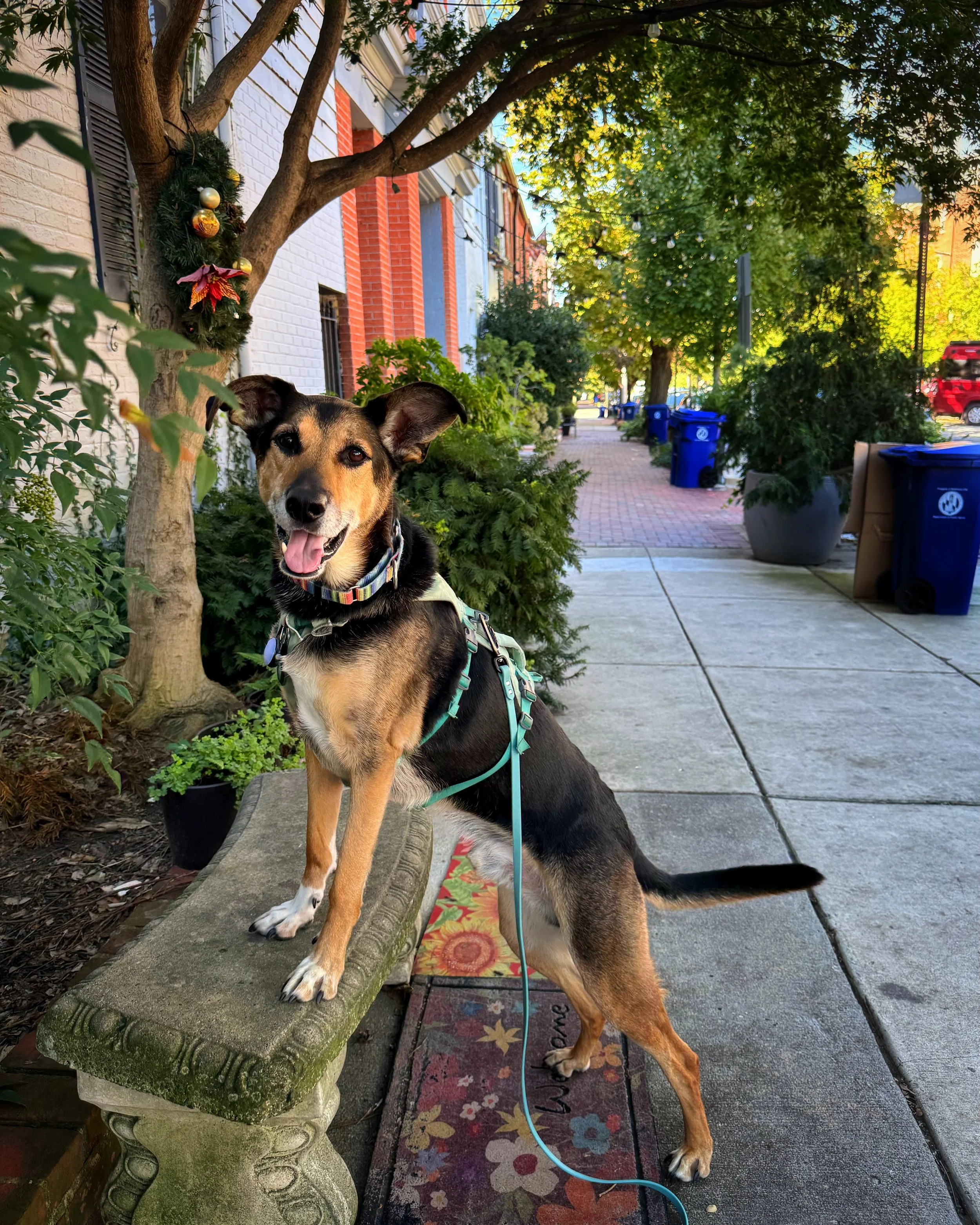
“Paws up” can be used with anything safe to stand on. It’s a great engagement and management tool during walks, and very helpful for photos.
Pre-requisite skill: “Paws up”
There’s one pre-requisite for most of these exercises, and that’s “paws up,” which is standing with front paws elevated on something, like in the photo.
Great news: It doesn’t take long to teach this cue! Most dogs will readily do this with just a little encouragement. Here’s a brief tutorial suitable for most dogs (it also shows you how to do some of the paws up-related exercises below).
If you try to teach this and your dog really avoids the stool, don’t panic. Switch to using a thick hardcover book instead of a stool. Once they get the concept, slowly increase the height of the object they’re standing on until they’re on the stool.
Stretch, massage, mobility
Stretch the back and hips (paws up and lean)
Quad massage - could be a good cool down activity
Bicycle mobility movement - great for knees
Exercises using “paws up”
Lifting each paw while in “paws up” - shoulder and core strengthening, joint health, builds confidence & stability
Variation: Standing on big yoga block-looking things
More advanced variation: Using a bosu ball-type thing under back legs - activates quads and stabilizes kneecaps
Paws up to sit - builds hindlimb and hip muscles, builds stability in the hind end (this is also in my “paws up” tutorial linked above).
Pivot - hind end awareness, engage legs properly, strengthening each side (this is also in my “paws up” tutorial linked above).
Fixing a “sloppy sit”
Variation of paws up to sit using a towel.
This exercises uses a padded block - stability, better muscle recruitment, stronger hips and knees.
Exercises using ground poles
Walking over poles - increases range of motion in leg joints
Last but not least, check out this video that shows the human equivalent of some of these exercises… it’s more intense than you think!
Additional resources:
Instagram: The Dog Wellness Centre
Instagram: Canine Conditioning Coach
Canine Fitness Equipment Cheat Sheet (from Canine Conditioning Coach)